

The Scuttlebutt About SCOTUS
The media's knee-jerk reporting has only gotten worse


This week, the Supreme Court wrapped up it’s October 2024 term by finalizing some last orders and remaining cases. Most of the cases were disposed of last week, leaving a series of big decisions for the American public to grapple with and the media to report on. And, per usual, I was left shaking my fist in the air not just at the decisions, but at the frustratingly confusing reporting about them.
When you’re cursed with both a law degree and a doctorate relevant to the study of law and politics (and you teach on said subjects), keeping up with the activities of the Supreme Court of the United States (SCOTUS) is part of your life. I know the reporting—especially the early reporting—on the big SCOTUS cases is going to be bad. Whether it’s reporting on the content of a decision, the meaning of an order, or the relevancy of oral arguments to the ultimate holding in a case, the media leaves a lot to be desired when it comes to their coverage of the Court.
Oral Arguments: Oracle or Misunderstood Musical
When SCOTUS grants certorari to hear a case, it requests briefs from both parties and schedules oral arguments (usually). These oral arguments are intricate dances between counsel for the parties (and sometimes, the Solicitor General giving the U.S. government’s opinion) and the justices who are asking questions. The questions that are asked are the kinds of things that law school dreams or nightmares are made of, depending on whether you enjoyed moot court. They pose hypotheticals, drill down on terms, pose extensions of the policies that may occur as a result of a ruling in one direction or another. Justices ask questions both to show their cards and to obfuscate their viewpoints. Some justices (ahem, Justice Thomas) spend a great deal of their career in silence, asking very few questions. Others are prolific questioners.
But journalists everywhere are content with making grand predictions based on the questions asked and the statements made by justices in their questioning.
This crystal ball gazing is particularly frustrating when you have argued in an appellate setting and know how obtuse and truly hypothetical the questions can be. Sure, some justices might be signaling how they may rule. But oftentimes, the journalistic impulse is to read into these questions through the lens of the prior ideological leanings of that justice, making determinations of the questions’s intent based on ideology. That tactic can work sometimes. That said, you probably would have been just as successful in your prognosis without the benefit of listening to oral argument at all, because it’s really the ideology you’re using, not the questioning. But, in this case, you’re reporting on the questioning as fact, rather than as the blend of fact and analysis that it truly is.
This leads to imperfect results and untrustworthy journalism.
For example, take this past term’s case regarding the constitutionality of Oklahoma’s religious charter schools plan. Justice Barrett took no part in the decision of the case. But back when the case was argued, Adam Liptak of the New York Times suggested that SCOTUS seemed “open” to Oklahoma’s plan. (The Washington Post agreed as did Politico.) While noting that Barrett’s recusal and Robert’s open questioning could lead to a tie, Liptak also nodded to the argument largely reaffirming ideological ties and leaning toward a win in Oklahoma’s favor.
Prognosis: wrong. Ultimately, the Court was equally divided and therefore affirmed the decision of the court below blocking the implementation of the religious schools.
Other cases reveal similar biases. (The 2019 DACA case? Wrong prognosis.) But the charter school case is illustrative for a few reasons.
First, it relies on prior ideological leanings to set the stage for future rulings.
Second, it supposes that questioning is statement making 100% of the time.
Finally, it shows a bit of a pile on effect with multiple outlets.
Usually, Liptak and the Times are the first ones to publish. Liptak took over for Linda Greenhouse, a very well respected journalist who covered SCOTUS for decades. While Liptak now has the job, one could argue (and I do) that he does not have the same credibility. Yet the tendency to follow the Times that is so prevalent in journalism writ large and was truly in play when Greenhouse was writing on SCOTUS is still strong here.
Complex Decisions/Simplistic Reporting
My second source of immense irritation with reporting on SCOTUS affairs is the simplicity with which the media and the public want to understand the decisions of the highest court in the land. Yes, I agree that there should be a layperson’s guide that comes with the decisions. But frankly, that’s what the media should be doing. Instead, they have routinely spent the first day or two oversimplifying only to come back later and insist that it was the public—not them—that got it wrong in the first place.
We need to look no further than last week’s decision “on birthright citizenship” for our exemplar case. In fact, while the underlying case in Trump v. CASA does, in fact, have everything to do with birthright citizenship, the question before the Court was much narrower than that. And, I get it, the technical issue impacts the substantive one. But the reporting was completely unclear, even after the decision came out, making it easy for those on the right to dunk on those on the left, and more importantly for the entire population to be ill-informed.
While the case is about birthright citizenship, SCOTUS dealt with a very small procedural issue: whether district court judges could enact nationwide injunctions. This has actually been a question posed many times in recent years—and not just by conservatives. Progressives on the left have routinely raised this issue, for example regarding reproductive rights. This practice of forum shopping allows anti-choice litigants to get a friendly judge at the district level (there’s only one in a particular division in Texas’s Northern District and he’s also anti-choice), get a friendly panel at the circuit court level (it’s the Fifth Circuit, so you’re guaranteed an anti-choice panel) and then make your way to the now perpetually anti-choice SCOTUS. Even after a new federal judiciary rule, this particular district in Texas refused to assign cases more evenly. There is a genuine issue here and while the case that SCOTUS used to try and resolve it may not be the right one—and may lead to unintended consequences and bad policymaking—it is still an issue nonetheless.
But that story has been largely drowned out.
The Court’s decision last week was much more nuanced than early reporting would have you believe. What the Court said was that Congress has not empowered district courts to enact nationwide injunctions outside of a class action. (In fact, at least one class certification petition has now been filed.) Now, you can argue with how that works given a nationwide policy such as this. But the fact remains that the ruling was not that Trump’s birthright citizenship reinterpretation was correct—no such ruling has occurred and will not occur until the fall, if at all—but rather that the technical methods were not appropriate.
If you’ve read Marbury v. Madison (1803), you know that this is something well within the Court’s power to do.
When the ruling last week was announced, many initial reports were a bit dramatic in the wrong ways.
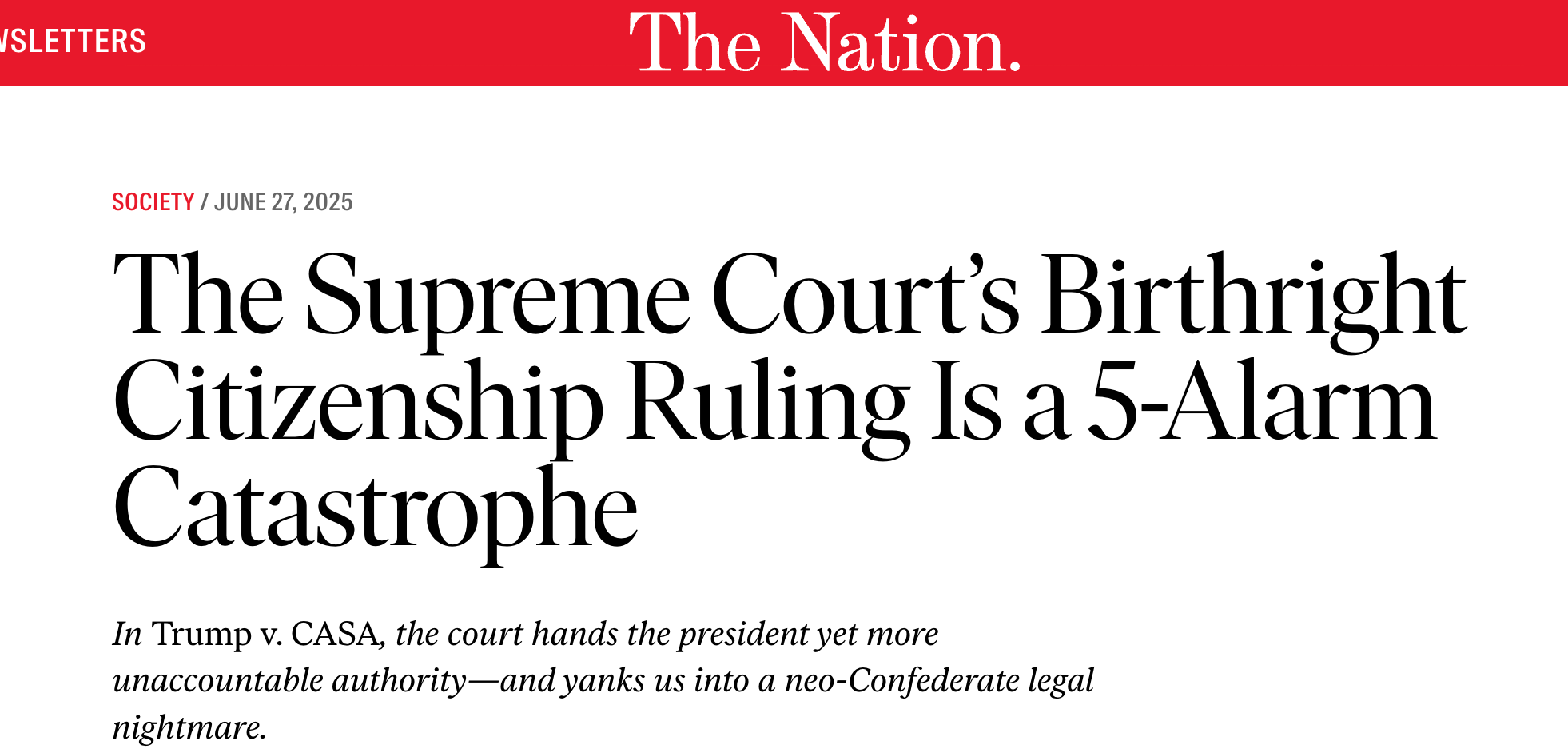
Without getting into my thoughts on the merits of the decision, I can tell you that speaking in hyperbole is not going to help people understand the case. Many news outlets have since revised their headlines to better match the Court’s actual ruling. But nevertheless, if you were to listen to people online or on the street, their understanding of the ruling is quite limited, meaning that the intermediaries here—the media, in particular—has not done its job.
What this all means…
Legal reporting is difficult. Most legal reporting comes in two forms: the reporting for lawyers that is highly technical and presupposes prior legal knowledge -or- the extremely flattened and often sensationalized reporting that is done in mainstream media. The former is inaccessible to most. The latter is not helpful for all.
I would offer two potential solutions.
First, the legal community needs to do a better job of articulating these cases and their impact for the general public without relying on intermediaries. Some groups already do this at an interest group level, but I am talking about the work of non-ideologically based entities. Unfortunately, Scotusblog was recently bought out and much of their back catalog is no longer available (and I worry about future content given their new overlords, the Dispatch). Oyez.org is great, but it relies on more understanding than the average person has. We need something more.
Second, the media—especially the legacy media—has to get better at reporting these cases. Yes, I’m looking at you, Adam Liptak. Focus less on oral arguments and more about getting the interpretation of decisions out correctly the first time. Actually report on the briefing—that tends to be more impactful than oral arguments anyhow—and give readers a fuller understanding of cases in multimedia format. Bring your reporting into the 21st century while being objective. Report when you’re reporting and provide analysis when you’re analyzing. Separate opinion from reporting. The mix is not helpful.
And, as for the general public, you have a hard task ahead of you. But one thing I’d ask is that you find someone you trust who knows about these things and is willing to talk to you about them. That’s honestly the best way to learn. Keep an open mind and always be willing to admit that you don’t know what you don’t know.